Showing posts with label Sustainable Living. Show all posts

Wednesday, September 24, 2014

Conservation of Mass

One of the most profound things I learned in school was during my 8th grade Physical Science class and it has remained with me over the years. The Law of Conservation of Mass states (very roughly) that in a closed system, the mass of that system will remain constant over time.  The implication of this law is that matter can neither be created nor destroyed. It is simply reordered through a series of chemical reactions.

At a practical level this has huge implications. In the natural world, trees lose their leaves every year and those leaves enrich the soil for other plants. Plants turn energy and nutrients into plants, small animals eat the plants and turn them into energy, waste (which enriches the soil) and animal. Predators eat the small animals and turn them into energy, waste (again, enriching the soil) and predator. When the predators die, bacteria decompose the body and turn it back into free energy and its component parts again making it available for the plants. It's a brutal, yet elegant system. There is no waste. Everything is recycled and becomes nutrients for something else.

Consider this... If I bag all my grass clippings and take them to the dump, I am removing matter from my property and placing it in a landfill where it will eventually decompose, creating waste greenhouse gasses and leftovers. If I rake up and burn my leaves every fall I am using a chemical reaction to oxidize the leaves. The components of those leaves are not gone. The ashes represent what remains of the leaves on my property but the bulk of them were changed into hot gasses that were released into the atmosphere. In both cases, I am removing potentially useful matter from my property and creating waste rather than using it for my benefit. Likewise, when I drive my car to take the grass clippings to the dump, I am using the gasoline to produce energy to move my car by burning it. The gasoline is not gone, though. It is simply changed into heat and energy with the by products released into the atmosphere though the tail pipe in the form of waste gasses and water vapor.

Barry Commoner, a prominent biologist, ecologist author and former presidential candidate who passed away in 2012, wrote the book, The Closing Circle. In this book he draws on the Law of Conservation of Mass when he set forth his four laws of ecology. They are:
1. Everything is connected to everything else. There is one ecosphere for all living organisms and what affects one, affects all. 
2. Everything must go somewhere. There is no "waste" in nature and there is no "away" to which things can be thrown.
3. Nature knows best. Humankind has fashioned technology to improve upon nature, but such change in a natural system is likely to be detrimental to that system"
4. There is no such thing as a free lunch. Exploitation of nature will inevitably involve the conversion of resources from useful to useless forms.
Commoner's four laws are so obvious, yet so easy to overlook that it's scary. We are all interconnected - in so many ways. This is not just a World of nations, We are a planet of people and other species with a shared future. Landfill space is becoming scarce and nobody wants one in their back yard. We have developed farming methods that deplete and poison the soil for the microorganisms that live in it while the run off is polluting our rivers and oceans.

Finally, Law #4 is probably the most profound to me. We continue to use our resources faster than they can be replenished. We burn them, use them, break them down into their component parts, mix them together so their not recyclable and then throw them into the landfill where they sit forever, never to be seen again. One day those resources will be gone.

One of the best things we can do for our planet and everyone/thing on it is work to eliminate waste and/or harness it to our benefit. That's where the three R's come into play.

Reduce - Cut back on the stuff we use. Reduce trash, reduce stuff, reduce size, cut waste, or find more efficient ways of doing things.

Reuse - Find other purposes for things that are no longer needed or wanted OR find someone who wants it when you're done rather than sending it to the landfill

Recycle - Cut the amount of resources that go into a dump never to be seen again. Recycle waste food into useable food for other things and compost. Maximize your recycling program at home and work.

These are some of the things that drive our thinking here at Red Clay Farm. We try to find ways of keeping our organic material here on the farm and using it to our benefit rather than sending it to decompose in the landfill. We also work to reduce our waste as much as possible. Here are some of the ways we do that.

Animal Manure - This is composed of grass from our pastures, hay and feed that we have brought in to our farm. It is gathered routinely and composed with straw, leaves or grass clippings. We use it to spread back on the fields to enrich our soils. This way, we get more benefit from the money we spend on hay and feed. Not only does it go to keep the animals alive, but what is not useful to the animals is useful to the grass, and the microorganisms living in the soil.

Left-over human food - We make every effort to not send food scraps to the dump as well. vegetable matter gets put in the compost pile. Meats, fats and other non-compostable items get fed to our Black Soldier Fly Larvae (more on these in a later post). These guys make short work of any table scraps and, in turn, provide a tasty supplement to our chickens and, eventually, our aquaponics fish (our vegetarian tilapia don't like them). In this way we are turning our food scraps into chickens and eggs.

Paper, cardboard, etc - These items are shredded and used for various things such as worm bedding, chicken coop bedding and composting. We use broken-down cardboard boxes for sheet composting in the garden.

Recyclables - Our county recycles plastics, aluminum and glass so we make sure we support these programs.

Water - We live on a gentle slope that starts at the top of the property and runs towards the back of the property toward a creek. The contour of the property naturally channels rain water down the middle of the property. We are now developing a plan to try to stem the flow of water off of our property and keep as much of it as we can. Additionally, we are installing rain barrels at the gutter down spouts to keep that water as well.

Usable stuff - Items that we no longer want or need are donated to the local Habitat for Humanity Re-Store and to Goodwill.

We still have a long way to go, but we've started. Anything that we can use to enhance or enrich our farm stays on the farm. Anything that can be recycled in some way or another is. In this way we have greatly reduced the amount of trash we send to the land fill.

Hopefully this is not too long and manifesto-sounding. The long and the short of it is we can't just throw things away because there really isn't an "away" these days. All we need are a basic understanding of the natural laws of the world, some integrated solutions based on that understanding, and a willingness to make the changes in our lifestyle to implement those solutions and we can begin to make huge changes in the way we affect the Earth.

Tuesday, August 19, 2014

Ignorance Is Bliss!


This is one of my favorite Calvin and Hobbes strips, and it is SOOO true! This is what we're facing with climate change, resource over use, etc, etc, etc. Nobody wants to face the truth - ignorance is bliss. It would be nice to un-learn what I already know and live as though we have no problems. Unfortunately, I can't do that. I can see the cliff coming.

Sometimes change isn't fun, but I think it's better to do it on our terms than to have it thrust upon us without choice. We need to start making changes now.


Saturday, March 29, 2014

The SC Organic Growing Conference

Earlier this month I attended the SC Organic Growing Conference in Greenville, SC. The one-day conference was sponsored by the South Carolina Organization for Organic Living (SCOOL) and covered a wide variety of subjects. I wanted to attend all of the classes, but sadly, I could only choose four.

I attended the Vermiculture class, a Beginning Bee-Keeping class, a Black Soldier Fly (BSF) Larvae class and a Aquaponics class. All were very informative and instructional. I am now motivated to jump into some new experiments and make some adjustments to some old ones!

Vermiculture Class - Paul Coleman of EarlyBird Farm in Hodges, SC gave a great class on vermiculture (vermiculture being the raising of worms. Not to be confused with vermicomposting; the use of worms to produce worm castings). He covered the basics of worm farming and showed pictures of his vermiculture operations. He also showed the class how to make a home-made worm bin out of a rubbermaid tote and filled it with a half pound of Belgian Red Worms. He then drew names to take the bin and worms home. I was the lucky winner - Wooo Hooo!

The beginning bee-keeping class was very informational. The lady who gave that class was working towards earning her Master Bee Keeper's certification. I learned a lot about bee keeping in that 90 minutes but I'm sure we only scratched the surface. Just a week prior to this class I had just ordered a beginning bee keeping kit. This class got me excited to get going on the bees. More to follow on that in a later post.

Black Soldier Fly Larvae Class - OK. Maggots can be just plain gross, but these guys are amazing. Watch this 22 hour time-lapse video. The black soldier fly is an insect that is prevalent across the US but especially in the Southeast. They spend the bulk of their life cycle in their larval form and are voracious eaters as they grow. When they're ready to turn into the black soldier fly they lose their digestive system and crawl off to find a quiet area to pupate. As an adult fly, their sole purpose in life is to mate and they die shortly thereafter. Black soldier fly larvae convert food waste into usable protein that can be fed to chickens or fish as a food supplement.

Aquaponics - This class was focused on how to build and operate an aquaponics operations. I learned that I was doing somethings improperly with the IBC system I set up last year so this year I will make some tweaks that will hopefully give us better results.

The organic growing conference was a great opportunity to learn and meet people. Best part of it was learning that I was not the only crazy person in the world interested in this stuff. There are a bunch of us out there!

Monday, October 14, 2013

Project Mushroom

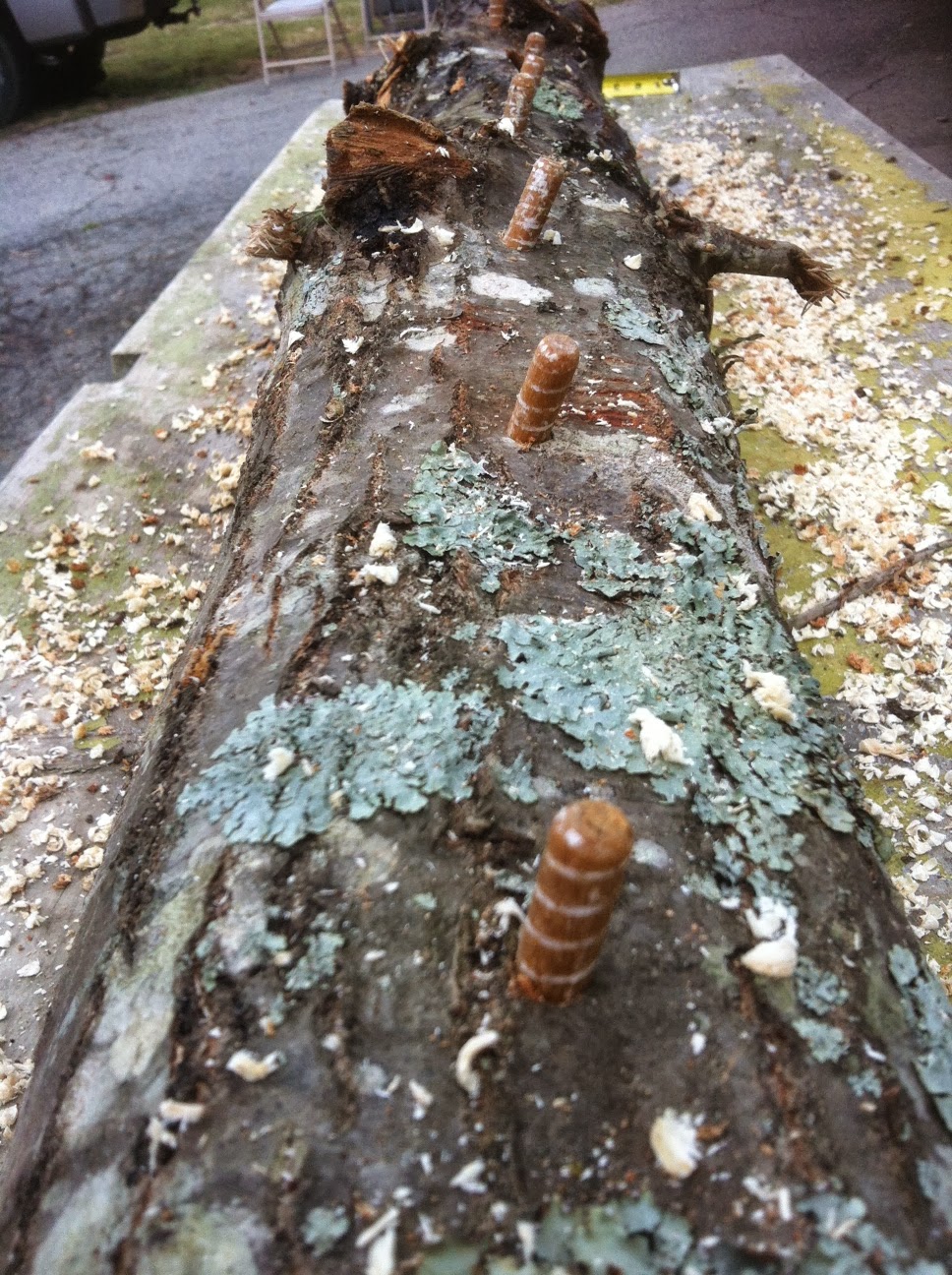
For the record, I am not a huge fan of mushrooms. I'll eat them if I have to or if it would be too hard or too messy to pick them out, but they're not something I choose to eat. Because I don't like mushrooms, I'm not really sure why I started this project. It just seemed like a cool process that I would like to try. I guess I will have to learn to eat them soon. I spent Sunday afternoon working to inoculate several oak logs with shiitake spore plugs. The process was fairly easy and if it works, we will probably be swimming in the things sometime in 2014.

1000 (more or less) shiitake plugs
To start, I ordered 1000 shiitake spore plugs from Fungi Perfecti. This was way more than I needed but I never do things small and knew I would need more than the next smaller bag of 100. The plugs arrived in a box very shortly after I ordered them. Included in the order was a bag of soy wax chips for sealing the plugs in the log once they are inserted into the logs.

For the growing medium, we had a small oak tree that, for some reason, had been bent over and looked like an arch over the pasture fence. I cut the tree down and into 4' lengths and let it age for about three weeks. This allows time for the tree's natural defense mechanisms to break down. Then, on Saturday, I began soaking the logs in water for about 24 hours. On Sunday afternoon, I "planted" the plugs using a 5/16th" drill bit. According to the instructions that came with the kit, the holes should be 1.25" deep and 4" apart.

Plugs before they are tapped into the holes
Sealing with wax
After drilling the logs, I placed the plugs in the holes, tapped them until they were flush with the log, then used a bolt to tap them the rest of the way down into the holes.  After the plugs were all the way in, I sealed the holes with soy wax injected with an old syringe.

The process was not very hard but it was a little time consuming and took the better part of the afternoon. Now all we do is place the logs in a shady area, water occasionally and wait for the right time to harvest. We will update the blog once things start happening with them. Until then, here is a link to The Urban Farming Guys discussion on growing mushrooms; pretty cool stuff.


Friday, June 21, 2013

5 Things to do with Shredded Paper

In an effort to combat identity theft and reduce the waste we produce in our house, we shred all of our papers with personal identifying information, most of the junk mail and many of the light cardboard food boxes and toilet paper/paper towel rolls that would otherwise end up in the trash can. This makes for quite a supply of shredded paper for which we have to find a use. Here are five ways we use our seemingly never ending supply of shredded paper:

1. Use as a compost additive. Paper has a high carbon content and us usually somewhat absorbtive so it lends itself well to mixing with high nitrogen content compost items such as grass clippings and food scraps.

2. Use as chicken coop bedding. Once every couple of weeks I add a thin layer of shredded paper to the chicken coop. Again, it's high carbon content mixes well with the high nitrogen chicken waste to produce a fairly nice compost once it is cleaned out and stacked for a while. Rather than adding it directly to the garden, we put it in the compost bin and mix it in with the other compost to make sure it cooks for a little while to kill any pathogens.

3. Use as worm bedding. Worms love paper. When starting a worm bed, I will add damp shredded paper to the bed first to give the worms a good start. I also occasionally add the shredded paper to an established worm bed to provide some additional food.

4. Use as a packing material. Cross cut shredded paper makes great packing material. It's free and it's much better for the environment than styrofoam peanuts.

5. Use it as kindling for starting a fire. Shredded paper ignites quickly and burns well, making it an excellent kindling. We use it to start our annual New Years Eve bon fire with great success.

Wednesday, May 15, 2013

Biodiesel

My First Batch of Biodiesel. The top, lighter layer of
liquid is the biodiesel, the darker layer at the bottom
is the glycerol separated from the cooking oil
A few years ago, I worked with a guy who ran his '80's something Mercedes diesel on used cooking oil he got from a friend of his who ran a diner. He would filter the cooking oil as he poured it into his garage holding tank, and then pumped it straight into the fuel tank when he needed a top-off. I always thought that was a great idea!

It's entirely possible to run a diesel engine like this, but it can cause some problems with the engine over time (which is why my friend used an old car). He said that he would frequently have to change his fuel filter and that his car smelled like french fries going down the road.

There are relatively simple processes that will allow a person to convert used cooking oil (animal or vegetable) into biodiesel that can be used by any diesel engine without the challenges that burning straight, used cooking oil presents. Today I spend an hour or so learning to make my own small batch of biodiesel.

There are many places to find info on the subject of biodiesel brewing, but for this table-top version, I turned to the National Sustainable Agriculture Information Service and their biodiesel page. They have a PDF entitled Biodiesel: Do-it-yourself production basics that has the recipe for this small batch. I was surprised at how easy it was to make it - just three ingredients and about 45 minutes and it was done.

For this particular batch, there are a couple more steps before it is useable biodiesel. I still have to separate the glycerol and wash the biodiesel to remove the soaps, residual glycerol, methanol and lye. Then it should be good to add to Bob the Tractor's fuel tank. The idea of being able to make my own fuel from waste oil is exciting! In the summer we use about 6-10 gallons of diesel every month. That's a $30-$40 savings every month if I could make enough. Plus, it removes waste oil that may be sent to the landfill and is cleaner and more efficient than petroleum diesel.

If you decide that you want to make your own diesel, be careful! The process uses some pretty nasty chemicals; methanol and lye specifically, that are bad for you. Make sure you wear rubber gloves and eye protection. Also, make sure that you don't release the chemicals where they can contaminate the environment.


Monday, April 22, 2013

Happy Earth Day!

Today is Earth Day! Take a little time to do something good for this wonderful, beautiful planet that supports and sustains us!

- Plant a tree
- Plant a garden
- Ride a bike
- Walk
- Drive less
- Reduce, Reuse and/or Recycle
- Compost
- Start a worm bin
- Find a way to reduce your energy consumption
- Sit outside and enjoy the fresh air and sunshine
- Think of ways to incorporate some of these things into your day, every day

Happy Earth Day, but lets not limit it to once a year!


Thursday, February 21, 2013

Sustainable Williamson Project

I wanted to take a moment to share a project from a fellow Appalachian State University alum who is making a difference in the World!


From his most recent email release:

Dear Friends,

On March 1st, 2013, we are launching our campaign in an effort to raise support for making the coalfields of central Appalachia sustainable and economically diverse! 

Our hope is to start a movement to make Williamson an example to other communities in central Appalachia and across the nation, changing how we approach economic diversification and sustainable development.

We aim to create a replicable model from our existing projects that positions Williamson as a hub for sustainability throughout the central Appalachian region.

We invite you to join us, taking action in sharing this campaign with your friends, family, communities, and networks. And as we begin our Campaign Tour across the east coast, stay tuned to our upcoming event to join us the national celebration for sustainability. 

We sincerely appreciate your support, and look forward to working with all of you over the next two months and beyond! Get excited with us! 


The Sustainable Williamson website goes live on 2 March. Check it out if you have a chance.

Tuesday, February 19, 2013

The New Garden Update

The garden is slowly taking shape!

I added four cubic yards of mushroom compost from Allen's Market this week and mixed it in with the tiller. Then, planted two rows of potatoes (both white and red), a row and half of onions (white, yellow and red) and seven cabbage plants. We're not too fond of cabbage in our family, but we are going to try it again. Maybe it tastes better when you've grown it yourself. I sure can't wait for things to start growing!

The folks at Allen's were very helpful when it came to offering advice on planting the potato and onion sets I bought from them. As I've said before, I'm pretty inexperienced in this gardening stuff. They also have some very reasonable prices on started plants. You get a three pack of plants for $1.00 - not too bad.

As for our sustainability score, I think we get an A+ for expanding out garden area. This new garden will really expand our ability to grow our own food. We probably get a D for the addition of the mushroom compost, though. While the compost will definitely improve our growing capacity, I later learned that it was shipped from mushroom farms all the way up in Pennsylvania. That's a long way to transport compost and I'm sure required a fairly significant quantity of fuel to get it here (and all the other places it was shipped). In the future, I will have to find a more local source of compost.

Saturday, February 9, 2013

Prepping a New Garden

We broke ground on a new garden this week. After all, it is the season to start planing! This brings us to two garden plots now. We started one beside the house the first summer we were here.

This particular garden is going to be a challenge. It's a 35' x 30' plot on a little bit of a slope. The area where we placed it used to be grass (kind of), and I've spent hours trying to rake out all the grass roots but they seem to keep popping up. I know I will be pulling grass out of the garden all summer long! Being on a hill, I sure hope the dirt doesn't all run out of the bottom side in a big rain storm.

I will be adding some mushroom compost to it soon because it is nothing but hard, red clay with a few rocks here and there. It definitely needs some organic material in it. It probably also needs a little lime added. We have some pretty acidic soil here.

We are going to plant some potatoes and onions in the near future. I think that's all we can plant at this time. It's not quite warm enough for anything else.

More to follow...

Monday, February 4, 2013

New Windows

There are hundreds of ways that houses waste energy. In the case of our house, I think we have thousands. Today we are taking care of one of those issues.

We are replacing the windows upstairs with new double pane, low-e energy star rated windows. The old windows original to the house were single pane wood frame windows. They had cracks, holes and the glazing was dry and cracked. It was time for them to go.

The new windows are Simonton brand windows. They're not the absolute best in the world, but they are pretty good, especially for the money we're spending. These particular windows are Energy Star rated in the south east (and other areas).

It's going to be interesting to see if these new windows make a difference in the comfort of the rooms and efficiency of the heating system. I can tell you that they look a heck of a lot better than the old windows did! 

Monday, November 28, 2011

Motivation for Sustainability


Diagram from http://en.wikipedia.org/wiki/Maslow's_hierarchy_of_needs

So, what does a picture of Maslow’s Hierarchy of Needs have to do with a sustainable living blog? As it turns out, quite a lot.

Maslow’s Hierarchy of Needs theory attempts to explain human motivation psychology. Maslow's theory suggests that people must meet the most basic level of needs (found at the bottom level of the pyramid) before they will focus motivation on the secondary or higher level needs (higher levels of the pyramid). As an example, most people will ensure they have food water and shelter before they worry about their own security, and before they reach out to become part of the community, they will likely focus on immediate security needs. This continues until, hopefully, a person reaches the top level of the pyramid.

While Maslow’s  model may not be perfect, it explains a lot. The ability to care about sustainable living requires that people be somewhere above the bottom two rungs of the pyramid. If a person is starving, why would he care if his actions are destroying the environment? All he is concerned with is meeting his most basic needs of having enough food and water for himself and his family. If he has not met his basic security needs, I’m sure we won’t find him setting up a compost pile or starting a recycling program. He has better things about which to worry.

I guess what I am saying is until we can get people to a particular level of basic needs, safety and security, we are never going to get everybody rowing in the same direction toward a sustainable future. In addition to getting people to a point where they care about sustainable living, there is also a HUGE education requirement. People need to know and understand the effects of their lifestyle upon the environment, and have alternatives that are not so burdensome that they are overlooked.

It’s a huge undertaking. I’m not sure how we get to a sustainable future from here. Until we come up with a plan, I’ll keep plugging along here.

Sunday, October 2, 2011

Now that I've Got a Blog, What Do With It?

A confession: I am a closet tree hugger.

After 23 years in the Army, I am finally coming out! I hate crowded, dirty places. Since our planet is about to top the 7 billion human mark any day (if it has not done so already), it seems there's not much I can do about the crowded part except learn to live with it.

What I CAN do is learn to live sustainably and reduce my impact on this world as much as I can. It's something we ALL can do with just a little effort. My goal with the blog is to share my quest with the World in the hope that I can be an example to others.

I am certainly not a purist. We are not going to do everything correctly, or in the most Earth-friendly manner. Let's face it. As a species, we humans are pretty selfish. If something is too hard to do, regardless of the benefits to ourselves and others, we're not going to do it. So, because of this we will be baby-stepping our way toward sustainable living in a way that is not too burdensome and may actually be fun.

I hope you will join us in our quest!

The Red Clay Farmers