Friday, June 20, 2014

Why Alpacas?

The Golden Girls the day we got them.
I am often asked the question, "Why Alpacas?" It's not a very easy question to answer because the simple truth of the matter is it just kind of happened. It all started a long, long time ago in a state, very far away.

Many years ago I walked into the Post Exchange (PX) at Fort Leavenworth, KS where a local alpaca farm had set up a display in the atrium of the store. They had spinning demonstrations, pictures and alpaca products for sale arrayed all around the display. I was captivated. At that point I had heard about this alpaca animal but didn't know much about it. Melanie and I spent quite a while there looking at the displays and asking questions.  After that day I started researching alpacas and frequently told Melanie that I wanted an alpaca farm when I grew up and retired from the Army. We kind of treated it as a joke but deep down, I was serious.

Fast-forward several years...

I began my transition from the Army in the winter of 2013 and my Army retirement ceremony was in February. One day shortly after the ceremony, Melanie made me get in the car and took me to Irmo, SC where we met a man who was selling four pet alpacas because he no longer had time to care for them. They were named after the Golden Girls; Sophia, Dorothy, Blanch and Rose. As my retirement gift, Melanie bought them for me. A week later we came back with the trailer to pick them up. Sadly, Sophia had an accident where she cut her eye severely on chicken wire and died before we could bring her home, but the other three became permanent residents of Red Clay Farm.

A few weeks later, I traveled to Emmitt Acres Farm in Bennettsville, SC to meet with an alpaca farmer friend I know. He was going to give me some pointers on raising alpacas. While I was there, he introduced me to 11 alpacas he was keeping on his farm. Their previous owner was a local farmer who had lost her battle with cancer and the alpacas were part of an estate sale. My friend told me I could buy the herd of 8 registered females, 1 registered male and 2 unregistered males for a song. So I did. A week later they arrived at our farm and joined the golden girls.

I suddenly found myself with an instant alpaca farm on my hands and I needed to figure out how to be an alpaca farmer. I'm still figuring it all out but we're making progress. That will be the topic of another post later on.
Some of the girls after shearing this year.
So, why alpacas? Here is my list of reasons:

1. I like them. They are interesting animals. They are curious, a little standoffish and cute.

2. They are a potentially profitable livestock and offer an opportunity to provide a product that does not require slaughter (although, that is an option. Alpaca is the other red meat in South America). Alpaca fiber is among the softest fiber there is. Additionally, alpacas can sell for a few hundred dollars to several thousand dollars depending on the market and the quality of the animal.

3. They are fairly low maintenance animals.

4. Alpacas have padded feet and are easy on the pasture (although if given a chance, will eat the grass to a nub).

5. Alpacas use communal dung piles which makes clean up fairly easy. We collect and compost the manure to improve our soil around the farm.

So, there you have it... the exciting story of an accidental alpaca farmer and why I do it. Stay tuned to this station for more news and information about alpacas, goats, worms and other miscellany.

Saturday, May 17, 2014

Bees!

I have been anxiously awaiting the time to go pick up my bees since I ordered them in mid-March! The 10th of May finally arrived and I drove just over two hours to Luray, SC where the Coosawhatchie Honey Farm is located to pick up my 5 frame Nuc of bees.

Anthony, the proprietor of the honey farm met me and talked me through the bee installation and gave me three points to remember. He said if I could master these three things I will be a successful bee keeper.

1. Never let the bees have more comb than they need because if they're not using it, something else, such as hive beetles and other bad things, will.

2. Learn what the queen's eggs look like. Eggs are only eggs for about three days before they hatch into lavae so if eggs are in the hive, the queen was active at least three days ago.

3. I forget.

I guess I have a 66% chance of being a successful bee keeper. It's been 5 whole days and they're still alive - so far, so good!
Pulling the frames out of the nuc and installing in the hive

A healthy brood comb
I must admit that I was a little worried about installing the bees but it was really no problem. I put on my bee suit and started adding frames. Anthony told me that I should put the brood comb on the wall sides of the box and then alternate between filled frames and new foundation. Once the frames were installed I opened the queen and put her in the box to do her thing.

The queen and her attendants
For a while I was afraid that I was not going to get everyone in the hive. There were hundreds of bees who did not want to leave their nuc and every time I tried to shake them into the hive they would fly around and land on the nuc again. Finally I got smart and took the nuc box down to the house. Once it was gone, everybody started to get the right idea.

Every time I shook them out of the box they would swarm and land in the box again.
The final piece of advice Anthony gave me was to feed them a mix of two gallons water and 20 pounds of sugar until it is all gone. Once it is gone, then it would be time to install the next deep super.

They finally started getting the idea.
There is a lot of science, trial and error to this bee thing and the stakes are high. Not only are the bees dependent on me getting right, but they have required a substantial up-front cost for the hive, equipment and bees. Failure would be costly.

I guess I better figure out what that one thing I forgot is.


Friday, May 9, 2014

A Simple Farmer's View on Global Climate Change


Today I am going to depart from the descriptions of my loony experiments and discuss a topic of real importance. Three days ago, the government released the National Climate Assessment. The report finds that global climate change is here now and that human activity is most likely causing it. Coincidentally, the report was released just as I was finishing the book Hot, Flat and Crowded: Why We Need a Green Revolution and How it CanRenew America by Thomas L. Friedman so I am looking at the data presented in the report in a new light.

By now I think that most of us agree that the climate is changing in some way. We have higher highs, lower lows and our storms are getting larger and more severe. These changes are bringing a whole host of second and third order effects, as well. Freidman calls it “Global Weirding.” We can argue amongst ourselves for days about why the climate is changing and get nowhere. While I personally believe that we are affecting the climate with our waste production, I find this to be a useless argument. It has been so politicized over the years that it goes nowhere. Anyone can pick a set of data and use it to prove their point on either side of the argument. Liars figure and figures lie.

I believe that a better argument is this. The fact is that we are getting more crowded by the day and there are only so many resources on the Earth. The human population topped 7 billion just over a year ago and is steadily climbing. Across the planet are millions, if not billions, of people struggling to live a better life and they’re starting to make it – think China and India. The increased population and all those increased living standards are putting a huge strain on our global resources – air, water, land, oil, fuel, wood, minerals, etc. We are very quickly using all of our resources without a plan. In the process we are polluting our land, water and air and eliminating the Earth’s natural response mechanisms. What will happen when the larder is bare?

What happens when you can’t find what you need at a particular store? You go somewhere else, right? The same thing happens on the Earth. There are finite amounts of natural resources in the ground and growing on the land. As people find their land can no longer support them, they start migrating to other places. Cities, already swollen and overpopulated, will become more crowded. Infrastructure will become strained, causing unrest among the population. At a national level, nations will move to secure resources for their populations causing regional conflicts and war. The future is not bright if we continue down the road we’re on. We may not see it in our lifetimes but our children and our childrens’ children will.

We continue to deplete our resources at an alarming rate without any plan or consensus on how to move to a sustainable lifestyle. Politicians argue that any change in our current unsustainable systems will destroy our economy and limit our ability to compete on a global scale. That argument is rather short-sighted if you ask me. I guess that’s what we’ve become… a nation of short-term thinkers. Yes, there may be short-term pain for the country as we shift from a consumption economy to a sustainable economy but that short-term pain is far better than the long-term misery we are going to face if we don’t make some sort of change. Maybe we deserve that misery.

That brings me back to global climate change. We are just now starting to feel the effects of a warmer climate. Already we are seeing big changes; larger storms, record temperatures melting ice, droughts. Further down the road we will see increased ocean levels, reduced land and even bigger changes in climate and storms as we continue to pollute our air and trigger the positive feedback loop of carbon release from which we may not recover. But that’s not all! A recent study found that crops grown in a high carbon dioxide environment have fewer nutrients so not only will we be able to produce less food but it will be less nutritious as well. We can twiddle our thumbs and argue about who or what is responsible while our ship sinks OR we can take action. And here’s the thing… If we take action to move to a more sustainable economy, our greenhouse gas production will necessarily fall.

I, like Thomas Friedman, have a hope for a better day. Unfortunately, in the words of the former Army Chief of Staff Gordon Sullivan, “Hope is not a method.” We have to do something about it. My family works hard to do our part but our actions don’t amount to much more than one atom of a drop in a bucket. We ALL have to row in the same direction! I agree with Friedman that America has the World leadership role, the responsibility and the ability to affect lasting change, AND that we can benefit from making that change and being the world leader!

I am attempting to write this essay in a politically agnostic way and I don’t feel qualified to discuss the correct policy changes we need to make to affect a change. I’m sure there are many controversial decisions that must be made. If you’re looking for examples I wholeheartedly recommend Friedman’s book. I don’t know how we are going to do it given our current political climate. I just know we have to do something. Anything is better than what we’re doing now!

So now it’s up to us. Change is never easy. Change is usually controversial. Change is necessary for our survival and the survival of this planet I’ve come to love. What are you going to do to make a change?


Wednesday, April 23, 2014

IBC Aquaponics Update for Earth Day


Happy Day After Earth Day! Between work, an exciting HS soccer game, feeding the herd and working around the farm, there was just no time to add anything yesterday, but I am making up for it today.

One of the classes I attended at the SC Organic Growers Conference back in March was an Aquaponics "How To" class. During the class, I picked up a number of good pointers and things that I wanted/needed to change on our small aquaponics system that day. So, this year for Earth Day I updated our IBC Aquaponics system I built last year.

In the system I designed, our pump was always on and the growing bed was always filled with water. One of the things I learned in the class was that the water level needs to rise and fall. This is because there needs to be some level of oxygen in the growing medium for the health of the plants and to keep the stuff that gets trapped in the rocks from becoming a stinky, anaerobic mess. There are two good options for doing this; build a bell siphon or put a timer on the pump.

There are lots of resources for building a bell siphon. Here is a link to instructions on how to build one if you would like to try. If you do a Google search for bell siphon you will find thousands of great resources on how to make one. One day I might try to add one to the system but for now I took the easy route and added a timer. I chose a simple indoor timer (the pump plug is in our sun room) that I found at Walmart and set it to power the pump for an hour and turn off for an hour. This setting seems to be working well for now but I may make some changes to it once things get warmer.

The second addition I made to our aquaponics system is the addition of red wiggler worms to the growing medium. Apparently, no aquaponics system is complete without worms. They eat all the crud that gets added to the growing medium; fish poo, dead plant roots, bug pieces, etc. Occasionally a worm will fall into the tank below and provide some tasty protein for the fish. I only added a handful of worms to our system at first. I want to see how they do before I add more.

Worms are not affected by the water in the growing medium. They do not drown as I once thought they might. Worms conduct transpiration through their skin and can take in oxygen from water. Again, the trick is to let some oxygen in to the bed occasionally so they can breath.

This year I found a great local source of tilapia at Southland Fisheries and added 35 tilapia fingerlings to the tank instead of the goldfish we used last year. Tilapia are a good choice for a small aquaponics system for a number of reasons. First, they are fairly hardy fish and tolerate a wide range of water qualities. Second, they like and need warm water. This is especially important here in SC where it gets pretty darn warm in the summer. I should be able to keep the water in an acceptable range through the end of Oct which will give the fish plenty of time to grow.

Our final addition to the IBC Aquaponics system was to add some plants. Thirty-five fish will create a lot of waste that will need to be filtered out by the plants. We added a variety of lettuce, spinach and tomato plants to start with and I am looking forward to seeing them grow.

Just a word of caution on adding fish... Consider adding your fish gradually so you can condition the beneficial bacteria in the growing media. If you add too many fish at one time the waste they produce can overwhelm the nitrobacter in your system and the bacteria won't be able to handle the amount of nitrogen in the water. This can cause a major fish kill. Make sure to monitor the amount of nitrites and nitrates in the water and do a partial water change if it gets too high. You can get water test kits in any fish store. In our case, we kept goldfish in the tank all winter and added 10 tilapia about 2 weeks ago to get the nitrogen cycle started.

Well, that's it for this entry. If you have any questions about the things we did to our IBC Aquaponics system, please drop me a line. Happy Earth Day a day late!


Sunday, March 30, 2014

Bee Keeping

Bee hives near our old home in Pfeffelbach, Germany
Bees are fascinating animals and I have always been interested in them. Last year during the Midlands Farm Tour we met some folks who kept bees on their farm and that planted to seed in my mind that I would like to try my hand at bee keeping. So, this year - despite my minor allergies to bee stings - we are adding a bee hive to our menagerie. There are a number of reasons for my desire to keep bees.

1. I like honey and it is expensive!
2. Bees are excellent pollinators. 
3. Bee's are facing some survival challenges and I would like to do my part to keep them going.

For most of the winter I planned to build a top bar bee hive. I found a good plan for the hives and bought the wood. Unfortunately, time conspired against me and I found myself in the midst of spring, with no bee hive built and most of the following weekends filled with other activities. I decided to buy my hive and get started.
Our son in his new bee-keeping suit. He's excited
to be a new bee keeper.

After several Internet searches and some discussions with other bee keepers I know, I found a pretty good bargain at Walter T Kelley's Bee Keeping Site. I purchased the Deluxe Beginner Outfit which comes with the hive, a bee keepers shirt, veil and pith helmet, a feeder, a smoker and smoking material, and honeycomb foundation. I still had to assemble the hive and frames but it is pretty easy to do. All the parts fit together perfectly and the frames go together with no problems.

The next challenge was finding the bees to put in the hive. My goal was to have the hive built and bees installed when the orchard started flowering but quickly learned that we should have planned a little better. Most companies that sell bee packages are sold out until late spring. I finally settled on a bee company that could provide a package of bees on 10 May. I'll miss the orchard blooms this year.  Coosawhatchie Honey Farms sold me a deep 5 frame nuc (short for nucleus) that contains 5-6 pounds of bees, three frames of bee brood and two frames of honey. I'll have to drive a couple of hours to pick them up, but that's no problem.

That's where we stand right now. The majority of the hive is now built and ready to move to its permanent location. I'll keep you updates on this experiment as it progresses.


Saturday, March 29, 2014

The SC Organic Growing Conference

Earlier this month I attended the SC Organic Growing Conference in Greenville, SC. The one-day conference was sponsored by the South Carolina Organization for Organic Living (SCOOL) and covered a wide variety of subjects. I wanted to attend all of the classes, but sadly, I could only choose four.

I attended the Vermiculture class, a Beginning Bee-Keeping class, a Black Soldier Fly (BSF) Larvae class and a Aquaponics class. All were very informative and instructional. I am now motivated to jump into some new experiments and make some adjustments to some old ones!

Vermiculture Class - Paul Coleman of EarlyBird Farm in Hodges, SC gave a great class on vermiculture (vermiculture being the raising of worms. Not to be confused with vermicomposting; the use of worms to produce worm castings). He covered the basics of worm farming and showed pictures of his vermiculture operations. He also showed the class how to make a home-made worm bin out of a rubbermaid tote and filled it with a half pound of Belgian Red Worms. He then drew names to take the bin and worms home. I was the lucky winner - Wooo Hooo!

The beginning bee-keeping class was very informational. The lady who gave that class was working towards earning her Master Bee Keeper's certification. I learned a lot about bee keeping in that 90 minutes but I'm sure we only scratched the surface. Just a week prior to this class I had just ordered a beginning bee keeping kit. This class got me excited to get going on the bees. More to follow on that in a later post.

Black Soldier Fly Larvae Class - OK. Maggots can be just plain gross, but these guys are amazing. Watch this 22 hour time-lapse video. The black soldier fly is an insect that is prevalent across the US but especially in the Southeast. They spend the bulk of their life cycle in their larval form and are voracious eaters as they grow. When they're ready to turn into the black soldier fly they lose their digestive system and crawl off to find a quiet area to pupate. As an adult fly, their sole purpose in life is to mate and they die shortly thereafter. Black soldier fly larvae convert food waste into usable protein that can be fed to chickens or fish as a food supplement.

Aquaponics - This class was focused on how to build and operate an aquaponics operations. I learned that I was doing somethings improperly with the IBC system I set up last year so this year I will make some tweaks that will hopefully give us better results.

The organic growing conference was a great opportunity to learn and meet people. Best part of it was learning that I was not the only crazy person in the world interested in this stuff. There are a bunch of us out there!

Sunday, February 2, 2014

Wine Making

Our first vintage; a sweet white muscadine wine
In 2012 we had a GREAT crop of muscadine grapes so I tried my hand at wine making. The result was a pretty good (if I must say so, myself) muscadine sweet white wine. After 9 months of fermenting and racking, we put up 16 bottles of wine, one of which I am sipping on this evening.

We were not so lucky in 2013. Once again, we had a great crop of muscadines. Unfortunately this time, some critter ate them all before we could pick them. There were muscadine hulls under the grape vines, the pear trees and the apple trees. It was very frustrating and happened so quickly! I managed to harvest about 10 grapes last year - not quite enough to make a batch of wine.

In fact, 2013 was not a good year for any home-grown fruit. Our peach tree died, the pear trees didn't produce any pears. The apples were pathetic, the plums were sparse and you know the story of the grapes.
A small sampling of our 2012 grapes.

Since we didn't have any good fruit this year, I wanted to try my hand at making mead. Mead is a wine made from honey. After a little research, I decided I wanted to make a melomel. Melomel is a mead with fruit added to the mix.

I had a little free time this evening, so I decided to start a batch of melomel. It sounded much more tasty than just plain old honey wine. I could not find one recipe I liked so I decided to take the best of the ones I saw. I decided on a raspberry and honey combo. It sounded good.

So, after an evening of cleaning, boiling, and mixing, we have a bucket of raspberry melomel must sitting under the kitchen table fermenting for the next few weeks. In 3-5 weeks the primary fermentation will be complete and I will transfer it from the current bucket into a 3 gal carboy to sit for another 5 months or so.

More to follow as we progress in the process....

Here is the recipe I used to make the brew. It's pretty basic:

140 oz Honey - about 9 pounds - (note: All the recipes I saw said to use the best honey available - preferably orange blossom honey. This being an experimental batch, and fresh honey being quite pricey, I decided to go budget with Food Lion brand honey. I don't even know if I like mead, but it sounded interesting.
2 Bags of Frozen raspberries
1 pkg Red Star Montrachet Yeast
3t yeast nutrient

Some recipes call for the addition of orange and/or lemon juice, which sounded good, but I didn't have any on hand.

Saturday, January 25, 2014

The Bokashi Experiment

Our new composter and bokashi bran
Let me start by explaining that we don’t have trash service where we live. We take our trash to the recycling and trash drop station every few weeks. Food scraps don’t go in the trash cans at our house. Otherwise, the they would be so stinky by the time we got to the transfer station that nobody would want to take it. Further compounding our food scrap problem, we don’t have a garbage disposal because we’re on a septic system.  

All of our vegetable matter goes to the compost pile where it eventually turns into a nice, dark compost. That leaves all the rest of the food scraps; meat, fish, non-veggie matter, etc, that we have to do something with. We can’t put them in the compost pile because they will draw unwelcome visitors, bugs and will smell bad, we don’t have any animals that would eat them (besides Buddy the Farm Dog, but he has a temperamental  stomach), we have no garbage disposal and we can’t leave it in the trash.


So… what is a family to do? Previously, we saved all the scraps in a plastic bag and froze them until the next trash run. While we have a large freezer with lots of space, this really isn’t a good option either. Food rotting in the landfill produces methane gas and methane is an even worse greenhouse gas than carbon dioxide.

Enter the Bokashi Experiment…

Bokashi is a Japanese method of fermenting waste using a specific combination an anaerobic microorganisms. Anything can be Bokashi’d; meat, fish, dairy. Supposedly, the microbes complete the fermentation process in as little as two to three weeks. The finished product smells a little sweet and sour and can be buried in the yard, garden or compost pile. It can even be fed to worms (that may be a later experiment).

How does it work? All we really need to bokashi is a bucket with an air-tight lid on it, although I purchased a bokashi bucket with a spigot and a food masher. Food is placed in the bucket and sprinkled with a bokashi growing medium. My bucket came with a bag of bokashi bran. To properly inoculate the food scraps, start with a thin layer of bran on the bottom of the bucket then place about a 1" layer of scraps in small pieces (the smaller the better - this increases surface area), topped with a dusting of bokashi bran. Continue this layering until the bucket is full.

The inside of the bucket with the food masher
Bokashi bran in the bag. It smells a little like
sweet feed with a touch of sour.


The first addition to the bucket.

I started the bokashi experiment on 23 Jan with the remains of the New Year's Eve Party sausage and cheese dip and some leftover dumplings from Tuesday night's dinner. The bin is supposed to stay warm so the fermenting microbes can do their work. Melanie begrudgingly gave me permission to store the bin in the laundry room, which is adjacent to kitchen. That approval is only valid as long as there are no bugs or smells. I'll keep you updated on the progress as we go along. 

Free Straw!

I got a call this week from a guy cleaning out a barn. He asked me if I wanted the old straw he found in the loft. I made a trip (actually a couple of trips) to pick it up today.

What does one do with 84 bales of free wheat straw? Hmmm..... Let me count the ways:

1. Straw bale gardening in the spring.

2. Sheet composting for the garden.

3. Adding organic matter to the lawn and pastures.

4. Erosion control.

5. Sell it.

Items 1-4 are very possible. I don't know if there will be any left for #5.

More on what we do with it later...

Tuesday, January 21, 2014

The Case for Cast Iron Cookware

After my grandparents passed away, I inherited a heavy, black, crusty and well seasoned cast iron skillet from the estate. At the time, I didn't think about it much and it eventually got shuffled to the back of the cabinet where it was never seen.

One day I was cooking and needed an extra frying pan. All of our other frying pans were in use. I reached into the cabinet and pulled out the cast iron skillet. As I was using the skillet, I remembered my grandmother using this very pan. I then realized that it had been around for a very long time. It was solid. Sat flat on the burner and cooked evenly.  I wondered how many non-stick aluminum pans we have ended up discarding over the years because they rocked on the stove and/or were no longer non-stick. Yet this pan remained, still in excellent shape. I began looking at that pan in a different light after that day.

Since that time, the old cast iron skillet has become my favorite frying pan and I have added two other cast iron pieces to the collection, as well. I use the cast iron almost exclusively now. There are five good reasons for my abandoning the non-stick skillets.

1-  Non-stick pans eventually lose their non-stickiness. Where does all that Teflon go? My guess is that we’re eating our fair share of it. Teflon is not in one of the four major food groups and I would prefer not ingesting it.

2- The longer you use a non-stick pan, the worse it gets. The opposite is true with cast iron. The longer you use it, the better it gets – as long as it’s well cared for. Even when it's not well cared for, it is possible to rehab it and make it useful again.

3- Thin, aluminum, non-stick pans warp over time. Eventually, they no longer sit flat on the burner. I hate a pan that rocks on the burner. Cast iron remains flat.

4- Aluminum pans just don’t seem to heat evenly. The part touching the burner is always way hotter than the parts that hang off the side of the burner. This problem is compounded further if the pan is warped. The cast iron skillets conduct heat better throughout the entirety of the pan.

5-  Unlike Teflon coated pans, cast iron cookware can be scraped with metal. This means you don’t have to be picky about which cooking implements you use in the pan. (note: There are some warnings on the Internet that using a metal spatula can lead to damage of the seasoning of the pan. In my experience, a metal spatula, used reasonably, will not damage the seasoning of the pan.)

OK. Cast iron cookware is not without it's drawbacks. It's heavy, it's not perfectly stick-proof making it hard to clean at times, and it can rust if not cared for properly. These drawbacks seem small compared to the drawbacks of a non-stick pan. When presented with an option, I will reach for the cast iron every time. 

Monday, January 13, 2014

Home Grown Luffa

Everybody has seen a luffa at least once in their lives. Luffas are those rough, sponge-looking things that people put in the shower and never use. I'll have to admit, I was a little ignorant about what they were. I never gave them much thought and always just assumed they were some sort of natural sponge from the ocean. As it turns out, I was wrong.

I'm not sure how I came across the website, but last spring I found luffa.info and learned about growing luffas. On that website, they sell 50 luffa seeds for $6 so I decided to buy a pack.

I had great success starting the seeds in our sunroom. Unfortunately, we hardly ever go into the sunroom so I killed most of them with my neglect (it was a busy time). I did manage to salvage four plants. I put two next to our deck and two in the garden. Both grew very well and produced some nice luffas for us. As they grow, luffas look a little cucumbers when they're small, and grow into something about the size of a large zucchini.

We allowed the luffas to stay on the vines until well after the vines were dead this fall. This gave the skin of the gourd time to dry and made peeling them a little easier. Still, peeling the skin off was not easy.

Once they were peeled, we knocked the seeds loose and collected those for use this spring. Finally, we rinsed the luffa in a bucket of warm water to wash off the left-over luffa juice and let them dry in the sun.

We're going to try to grow some more this coming summer from the seeds we saved from these luffas. In the meantime, we are going to put the ones we grew last year to the test and see  what we can do with them. A brief search of the Internet revealed some great ideas for using the luffa fiber.

Here are some uses for the luffa:

- Use as a shower sponge to exfoliate the skin.
- Use as non-scratching pot scrubbers, particularly for those non-stick pans.
- Use as a bug gut scrubber the when washing a car.
- Mount on a stick and use as a back scratcher.
- Use as a filter medium in ponds and fish tanks.
- Use in arts and crafts projects.
- Use to texture painted walls.


Tuesday, October 22, 2013

EM-1 Fermenting


After three weeks, I had almost forgotten about my adventures in microbiology experiment where I decided to try to ferment some new EM-1. I had mixed the recipe, sealed the bottle and left it in the laundry room sink to do its thing. 

On Saturday afternoon I found it laying on its side in the sink. The bottle was as hard as a rock and the bottom had pushed out and no longer sat flat - a sure sign that life has begun and the various microbes are doing their thing in there.

Here is the recipe I used...

1 part EM-1
1 Part Molasses
22 parts (non-chlorinated) water

Mix the molasses and water and heat to 100°. Stir in EM-1 and seal the entire mixture in an air-tight container (EM-1 is largely anaerobic). If you can keep it warm, the fermentation process will begin quickly. The cooler the mix is, the longer the fermentation will take. I left mine at room temperature and had to wait almost three weeks before seeing signs of life.


Monday, October 14, 2013

Project Mushroom

For the record, I am not a huge fan of mushrooms. I'll eat them if I have to or if it would be too hard or too messy to pick them out, but they're not something I choose to eat. Because I don't like mushrooms, I'm not really sure why I started this project. It just seemed like a cool process that I would like to try. I guess I will have to learn to eat them soon. I spent Sunday afternoon working to inoculate several oak logs with shiitake spore plugs. The process was fairly easy and if it works, we will probably be swimming in the things sometime in 2014.

1000 (more or less) shiitake plugs
To start, I ordered 1000 shiitake spore plugs from Fungi Perfecti. This was way more than I needed but I never do things small and knew I would need more than the next smaller bag of 100. The plugs arrived in a box very shortly after I ordered them. Included in the order was a bag of soy wax chips for sealing the plugs in the log once they are inserted into the logs.

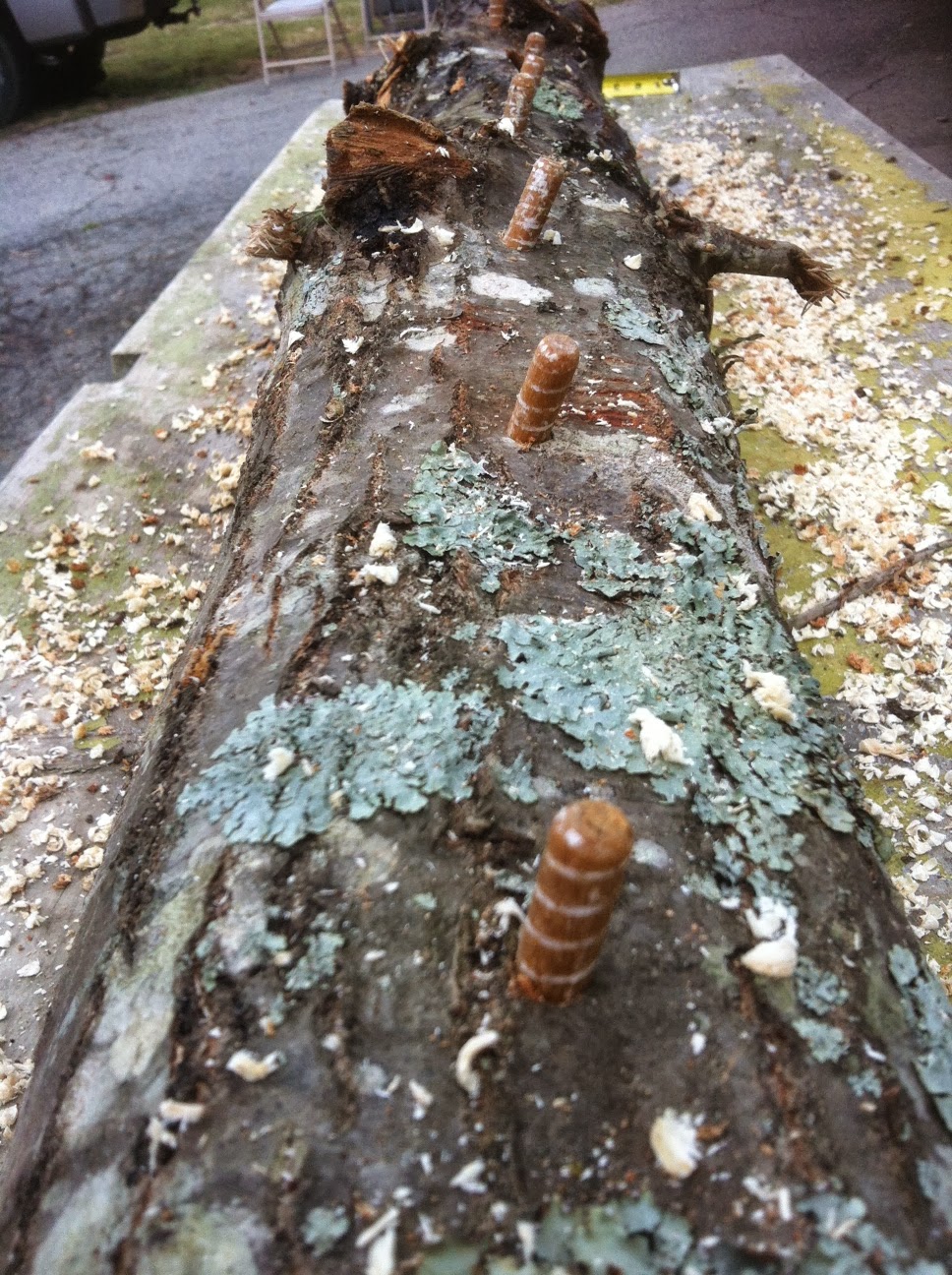
For the growing medium, we had a small oak tree that, for some reason, had been bent over and looked like an arch over the pasture fence. I cut the tree down and into 4' lengths and let it age for about three weeks. This allows time for the tree's natural defense mechanisms to break down. Then, on Saturday, I began soaking the logs in water for about 24 hours. On Sunday afternoon, I "planted" the plugs using a 5/16th" drill bit. According to the instructions that came with the kit, the holes should be 1.25" deep and 4" apart.

Plugs before they are tapped into the holes
Sealing with wax
After drilling the logs, I placed the plugs in the holes, tapped them until they were flush with the log, then used a bolt to tap them the rest of the way down into the holes.  After the plugs were all the way in, I sealed the holes with soy wax injected with an old syringe.

The process was not very hard but it was a little time consuming and took the better part of the afternoon. Now all we do is place the logs in a shady area, water occasionally and wait for the right time to harvest. We will update the blog once things start happening with them. Until then, here is a link to The Urban Farming Guys discussion on growing mushrooms; pretty cool stuff.


Saturday, October 12, 2013

Preserving an Alpaca Hide

Here is Sangria
We're not sure why, but Sangria the alpaca had not been well for about two weeks and we have been trying to nurse her back to health. After two trips to the vet, daily medications and lots of effort it became apparent that she was not going to make it. On Friday afternoon she died quietly in the shelter with her alpaca friends sitting watch.

Not being one to miss an opportunity, we turned her death into a learning opportunity. For those who are a little squeamish, stop reading here.

One of the main reasons for raising alpacas is for their fiber. Since Sangria was no longer going to need her's anymore, we decided to learn about tanning hides.

When I found Sangria dead on Friday afternoon, I picked her up and moved her to the back of the property. I had already prepared her grave there the day before because it was pretty apparent that she was not going to survive. I approached the task with some trepidation. While I looked forward to the opportunity to learn a new skill, I was not looking forward to the task of skinning the alpaca. It turns out it was not as bad as I thought it would be.

The skinned hide
Once we had her in position, my son and I worked together to skin her. It was relatively easy once we got it started. We started on her chest and worked our way around her body. The hardest part of the job was working around her legs. We skinned down to her elbows an around the leg. Once we got past that part it was easy and the skin just pulled away.

Scraping the hide. I really had to get into the
work to hold the hide in place while scraping.
After skinning her, we placed her in her grave, sprinkled a little lime on top and buried her. The next task was to scrape the hide and remove any fat and muscle that was still attached to the skin. This was the hard part. It doesn't come off as easy as you might think. At first I tried to scrape the hide with a knife, but I found that to not be very effective. Then I moved to the machete and worked on the curved surface of the log. That worked much better because I could apply firm pressure against a 1-2" section of the hide at a time. I worked from the center of the hide to the outside edges, making sure I removed all fat and muscle.

Once the hide was scraped, we had to salt the skin side to help remove the water from the skin. We laid the hide out, skin side up, on chicken wire stretched between two saw horses and poured about 5 pounds of salt on the it. Since then we have had to change the salt out several times because it soaks up the water and stays wet. I figure that can't be good for the uncured hide.

Salting the hide with about 5 pounds of
non-iodized salt.

I'm not sure if this little experiment will work, but we'll soon find out. I halfway considered doing the tanning myself as well, but didn't want to mess with the chemicals and the proper disposal of those chemicals. I think I'll leave that to the pros. In the meantime, we will continue salt-curing hide. Here are some of the links I used to educate myself before attempting this project:

This Mother Earth article talks about how to tan the hide:  http://www.motherearthnews.com/homesteading-and-livestock/how-to-tan-a-hide.aspx#axzz2hhLGreFl

http://www.dutchhollowacres.com/2010/03/28/alpaca-death-preserve-alpaca-hide-fur/

Also, YouTube has a wealth of information on how to prepare a hide for tanning. There were several videos that were particularly helpful, but I can't find them now. 

Wednesday, October 9, 2013

Erosion Control Update

Back in January, I decided that I had to do something to control the erosion on the property. Several years ago, the previous owner had clear cut the land and anything that remotely passed as top soil had long since washed away leaving us with nothing but thick, red clay (hence the name). Worse yet, there was a huge gully running down the middle of the side pasture that had developed over the years. Looking back at the old Google Earth pictures, that gully was here long before the land was clear cut.

This is just a quick update to my update earlier this year. After one of the rainiest summers on record here in the Midlands of SC, I am proud to say that my retention dams have, for the most part, done their job and remained strong. There are a few spots where the water washed over the dams and eroded little bits of the dam, but for the most part, they have done well to help control the flow of water down the hill. I have even managed to get a little grass growing on them to help hold them in place. My focus now is to improve the quality of the soil so I can get a better stand of grass growing, but that's a subject for a later post.

That's the good news. Now for the bad... While the upper part of the hill is doing well, down at the lower part of the hill the gully is beginning to re-emerge. It's steeper at that point and we had several large downpours that did some particularly bad damage to my work. I've got to get the box blade out again and do some more work. This time, I think I am going to have to reinforce my work with rock gathered from the property. Time to call out the troops to start picking up rock!

Tuesday, October 8, 2013

Guinea Fowl Update

Back in May of this year we added 9 guinea fowl keets to the Red Clay menagerie. The idea was that they would patrol the garden and property for insects and eliminate them. We were able to control the keets until they were about 5 weeks old. At that point, they were too large to keep in the brooder and it was getting warm outside so we moved them to their own place out behind the garage.

That arrangement didn't last very long. Soon after they moved outside they found a way to get out of their enclosure, which, at first, wasn't a problem. They hung out around the house most of the time and went inside to roost each night. But as time went by, they began exploring further and further away. First it was the front yard, then they were in the front pasture. One day I went to pick up the mail and found them on the far side of the highway foraging in the grass along the road as cars wizzed past. I figured they were gone for sure at that point. Every night they would find their way home but their numbers would dwindle each time we saw them. One morning we awoke to find a pile of feathers in the front yard. We never did figure out what got that one (I suspect Buddy the Farm Dog had a good meal that day).

And then one day there were just two left. These two must have been the smarter of the group because once it was just them, they decided to stick around the house and do their jobs. They have stayed in the area ever since and hang with the other chickens in the pasture.

They have proven to be very useful birds. I don't know how much of a dent 2 guineas can put in the insect population, but they do a great job of scratching up and spreading the horse manure which is good for reducing parasites and improving the soil quality. On top of that they are hilarious to watch. I'm pretty sure that these must be some of the dumbest birds on the planet and they provide hours of entertainment for the whole family.

Monday, October 7, 2013

The Persimmons Are In!

A small bucket of persimmons
We have a large persimmon tree in our front yard and I can tell it's Fall when the persimmons start falling off of it. This year looks as if it will be a bumper crop! Persimmons just taste like Fall to me and I look forward to all the great goodies we can make with them; persimmon pudding, persimmon bread, I may even try my hand at persimmon wine if we get enough. That might be good.

These are the native species of persimmon, not the big Asian varieties one can buy in the grocery store. They are small, seedy and kind of a pain in the butt to use because of all the large, black seeds they contain. After we gather the fruit, we rinse and dry them, remove the tops and then throw them in our food mill to make a persimmon pulp for use in our recipes later in the year. Most don't look very nice because they are very soft and get a little mangled after falling from 20-30 feet to the ground. I grind them up anyway so it doesn't really matter what they look like.

We used to take the time to pick the seeds out of the food mill and get as much of the pulp as possible, but this year I have decided it is not worth the effort for the little bit of extra pulp we gain. I am just running the persimmons through the mill once with a big screen and discarding what doesn't go though the holes. I then run the pulp from that through a smaller screen to make it just a bit more fine. A medium Tupperware bowlful of persimmons will make enough pulp for a double batch of persimmon pudding (about 2 cups)... Mmmm Mmmmm!

If you would like to learn a little more about persimmons, read this Clemson University Info Paper. Also, here is a great persimmon pudding recipe to try from food.com:

1 cup very ripe hachiya persimmon pulp (Editor's note: Of course you can use the wild species as well)
3/4 cup sugar
3 eggs, beaten
1 cup flour
1 teaspoon baking powder
1/2 teaspoon nutmeg
1 cup milk
1/4 lb butter or 1/4 lb margarine, melted
1/2 teaspoon cinnamon
Directions:

Combine persimmon pulp with sugar.
Beat in eggs. Mix in milk, then butter.
Sift or stir flour with baking powder, cinnamon, nutmeg.
Mix with persimmon mixture.
Pour batter into a well greased 9-inch square cake pan.
Bake in a 315-325°F oven for approx 60 minutes or until knife comes out clean.


Do you have a favorite use for persimmons? Leave a comment.